AP Statistics vs AP Calculus: Which Should You Take?
AP Statistics vs AP Calculus compared honestly on difficulty, workload, college credit, and careers, so you can choose the course that fits your strengths.
Ap Stats Calculator
Ap Stats Calculator
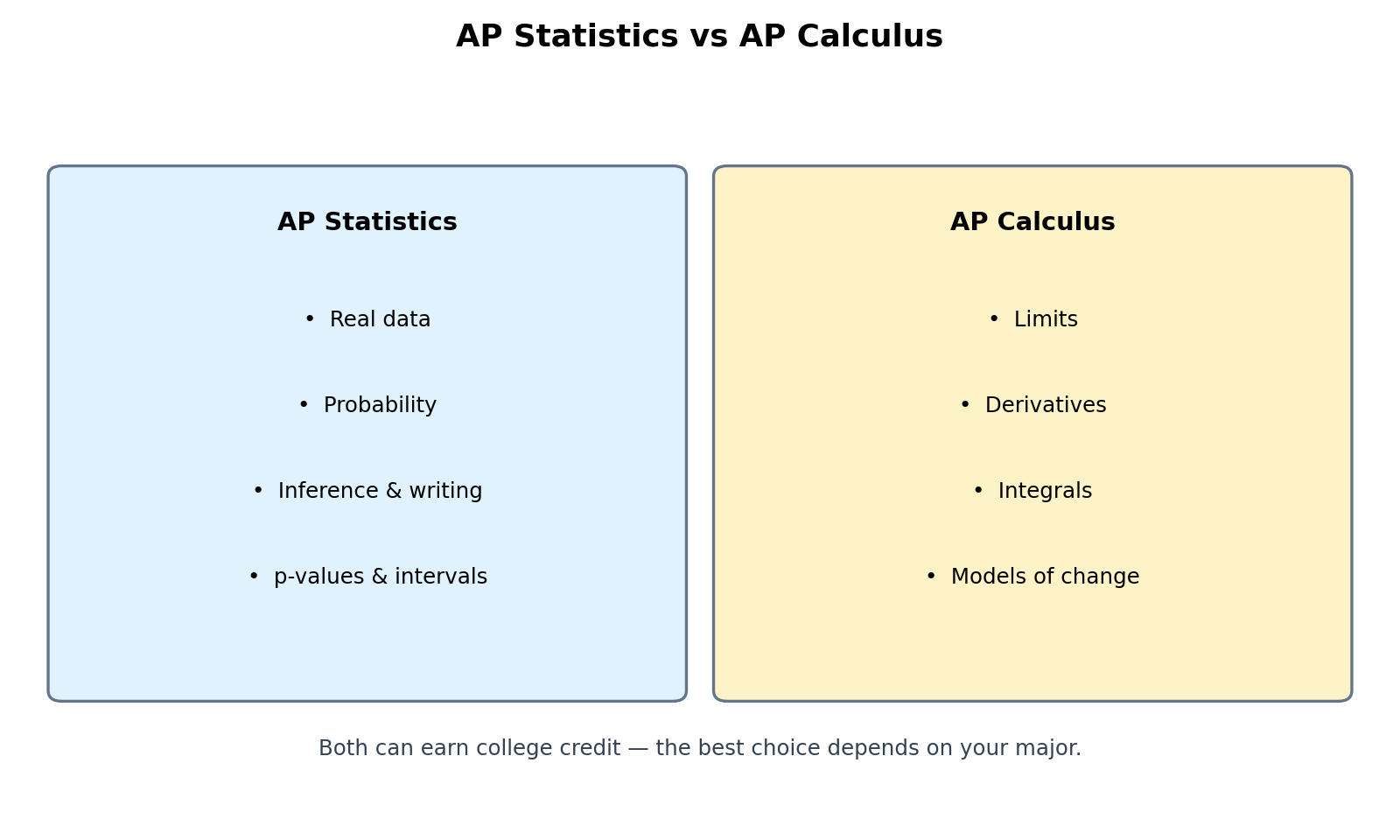
Choosing between AP Statistics and AP Calculus is a common decision for high school students planning math courses. Both are strong courses, both can earn college credit, and both look good on a transcript, but they teach very different kinds of thinking. The right choice depends on your strengths, your major, and how much writing about data you enjoy.
What Each Course Actually Teaches
AP Statistics teaches you how to work with real data. You learn to describe distributions, design samples and experiments, use probability, and carry out statistical inference. A large part of the course is interpretation: explaining what a p-value means, whether conditions are met, and what a confidence interval does and does not say. The math itself is mostly algebra-level, with no calculus required.
AP Calculus teaches change and accumulation. In Calculus AB, students study limits, derivatives, and integrals, and apply them to motion, optimization, and area. Calculus BC adds more, including series and parametric equations. The algebra and trigonometry background needed is heavier, and problems often require several careful steps of symbolic work. In short, statistics reasons with uncertainty, while calculus models exact change.
Difficulty: Which Is Harder?
Difficulty depends on the student. Students strong at algebra who enjoy step-by-step symbolic problems often find calculus more natural. Students who are strong readers and writers, and who like explaining ideas in context, often find statistics more comfortable, even though it has plenty of new vocabulary and careful conditions to learn.
AP Statistics can surprise students who expect an easy math class. The calculations are not usually the hard part; choosing the right procedure, checking conditions, and writing a complete conclusion is. A correct number with a weak explanation loses marks on the AP Statistics exam. AP Calculus can surprise students the other way: the ideas are elegant, but a small algebra mistake early in a problem can carry through every later step.
Workload and Homework
Homework in AP Statistics often mixes short calculations with written explanations. You might calculate a confidence interval, then write two or three sentences explaining it in context. Graphing calculator work is central, using normalcdf, t-tests, chi-square tests, and regression analysis on a TI-84 Plus or TI-Nspire, or checking work with a free online calculator.
Homework in AP Calculus is usually longer chains of problems: finding derivatives, setting up integrals, and justifying answers with calculus reasoning. A graphing calculator helps, but it does not replace symbolic work. In both courses, falling behind is costly, because later units build on earlier ones.
College Credit and AP Policy
Both courses can earn college credit, but policies differ by college and score. In general, a score of 3, 4, or 5 is considered passing, and many colleges give credit for a 3, while selective colleges may require a 4 or 5, or give placement without credit. Always check the AP policy of the specific colleges on your list, because the same score can mean different things at different schools.
For majors, the credit is not always interchangeable. AP Statistics credit often satisfies an introductory statistics requirement for psychology, business, health, and the social sciences. AP Calculus credit often satisfies a calculus requirement for engineering, mathematics, physics, and computer science. If you already know your likely major, that requirement is often the deciding factor.
Careers and Majors
AP Statistics is useful far beyond a statistics major. Data appear in medicine, business, psychology, public policy, sports, and technology, and employers value people who can read a study, spot bias, and explain uncertainty without overstating a result. Hypothesis testing, confidence intervals, and regression analysis are everyday tools in research and data analysis.
AP Calculus is essential for engineering, physics, mathematics, and many computer science programs, where later courses assume calculus fluency. It is also valued in economics and the physical sciences. If you plan a field that builds directly on calculus, taking it in high school can open up your college schedule. Statistics often has broader everyday use, while calculus has deeper use in a smaller set of technical fields.
Who Should Take Each Course?
AP Statistics suits students who like real data, are comfortable writing explanations, and want a math course that connects to research and everyday decisions. It fits psychology, business, health, biology, education, or the social sciences, and students who have not yet chosen a major, because statistical literacy helps in almost any field.
AP Calculus suits students who enjoy algebra and trigonometry, like multi-step symbolic problems, and plan to study engineering, mathematics, physics, or computer science. It fits students who have done well in precalculus and want to keep advanced technical pathways open. If your target colleges expect calculus for your intended major, that expectation matters more than a general preference.
Should You Take Both?
Many strong students take both, often in different years. A common plan is AP Statistics in one year and AP Calculus in another, or both in the same year for students with a very strong math background. Taking both gives two ways of thinking: calculus models exact change, while statistics models variation and uncertainty. Together, they are powerful for data science, engineering, and research.
Taking both in the same year is a heavy load, though, and it is not required for most college plans. If taking both would crowd out other courses or leave no time for steady practice, taking one well is better than taking two poorly. Talk to your teacher and counselor about prerequisites and scheduling at your school.
Frequently Asked Questions
Is AP Statistics easier than AP Calculus?
It depends on the student. The algebra in AP Statistics is lighter, but the writing, conditions, and interpretation are demanding. Students who dislike writing about data often find statistics harder than expected, while strong algebra students often find calculus more straightforward.
Do colleges prefer AP Calculus over AP Statistics?
Colleges value both, and preference usually depends on major. Engineering and physics programs expect calculus, while psychology, business, and health programs value statistics. A course matching your intended major usually matters more than a general ranking.
Can I take AP Statistics without taking calculus first?
Yes. AP Statistics does not require calculus. Most schools require Algebra 2 as a prerequisite, so check your school’s requirements.
Will AP Statistics help if I later take calculus?
Yes, in a different way. Statistics builds data sense, careful reading of problems, and comfort with technology and interpretation, all of which help in any advanced math course, even though it does not teach calculus content directly.
Conclusion
There is no single winner in AP Statistics vs AP Calculus. Choose statistics for data reasoning, interpretation, and broad usefulness across majors. Choose calculus for symbolic modeling of change and a pathway into engineering and the physical sciences. Choose both, in sequence if needed, if you have the time and background. Whichever you choose, practise with real problems and check your work with the free Ap Stats Calculator at www.apstatscalculator.com.
AP is a trademark of the College Board, which was not involved in the production of this site.