Binomial Probability Calculator Guide: binompdf and binomcdf
Learn binompdf and binomcdf step by step: n, p, and x explained, worked binomial probability examples, and the common mistakes students should avoid today.
Ap Stats Calculator
Ap Stats Calculator
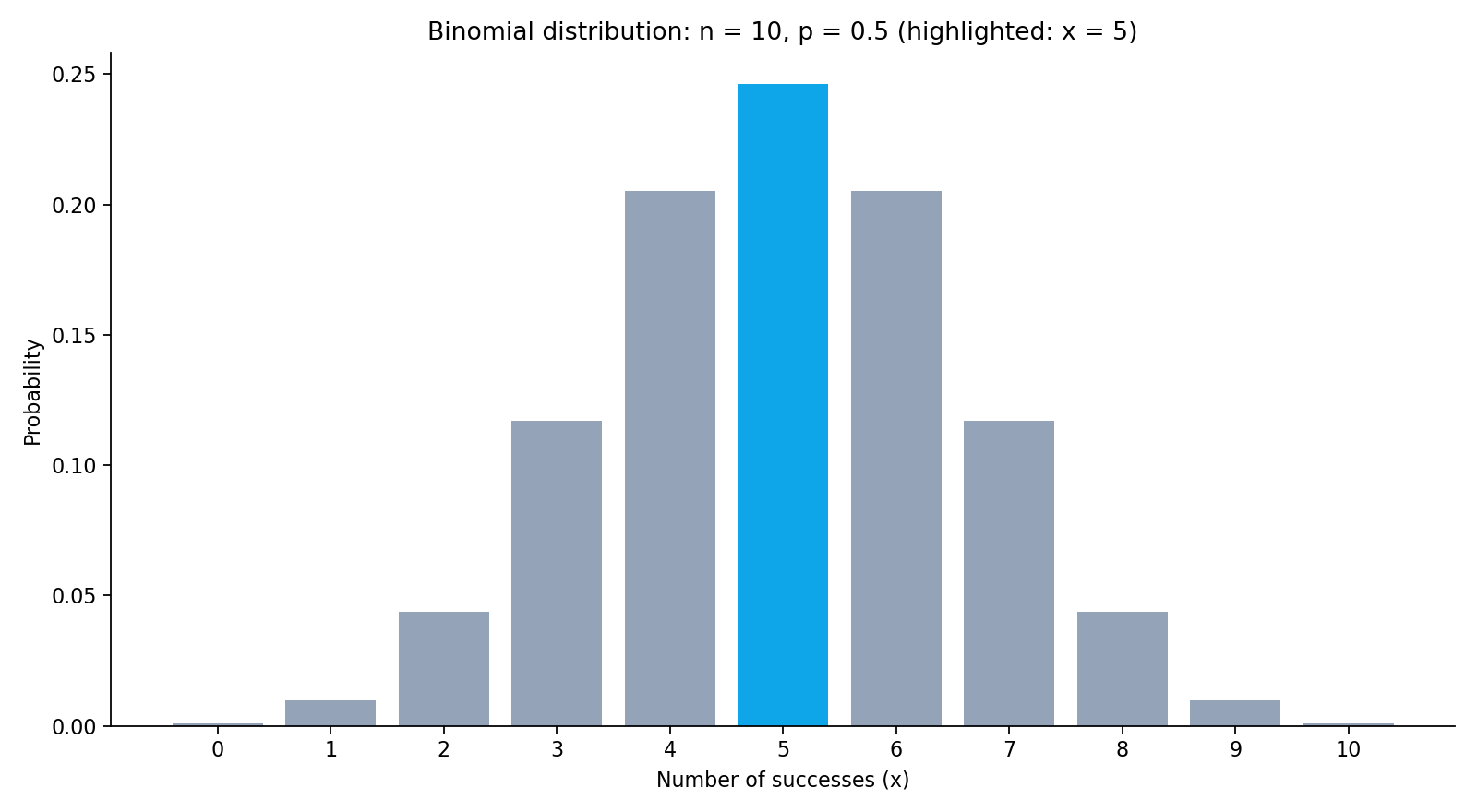
A binomial probability calculator answers a simple question: if an event has the same chance of success on every trial, what is the chance of getting a certain number of successes? Students meet this question in AP Statistics when they study the binomial distribution, a probability distribution for a fixed number of independent trials with only two outcomes. The two calculator functions you need are binompdf and binomcdf. One gives the chance of exactly a value, and the other gives a cumulative chance up to a value. Knowing which one to use is the skill that saves marks.
What Makes a Situation Binomial?
Not every counting problem is binomial. Four conditions must hold. First, there is a fixed number of trials, called n. Second, each trial has only two outcomes, usually called success and failure. Third, the probability of success, called p, stays the same on every trial. Fourth, the trials are independent, so one result does not change the chance of the next result.
A fair coin flipped ten times fits the model. Each flip is a trial, heads can be success, p is 0.5, and one flip does not affect the next. A survey of twenty students does not fit perfectly if the population is small, because sampling without replacement changes p slightly. In AP Statistics, the 10% condition is used to check whether independence is reasonable when sampling from a large population.
binompdf vs binomcdf: The Key Difference
Binompdf gives the probability of exactly x successes. On a TI-84 Plus, you open it with 2nd, then DISTR, then scroll to binompdf. You enter n, p, and x in that order. For example, binompdf(10, 0.5, 5) gives the chance of exactly five heads in ten flips, about 0.246.
Binomcdf gives the probability of at most x successes, from zero up to x. The TI-84 Plus command is binomcdf, found in the same DISTR menu. Binomcdf(10, 0.5, 5) gives the chance of five or fewer heads, about 0.623. This difference matters on every exam question. If a question asks for “at least” a value, you do not enter that value directly into binomcdf. You use the complement: P(X at least k) equals 1 minus P(X at most k minus 1). For example, the chance of at least seven heads in ten flips is 1 minus binomcdf(10, 0.5, 6), which is about 0.172.
The Inputs: n, p, and x
The three inputs are easy to mix up, so define them before you touch the calculator. The value n is the number of trials, not the number of successes. The value p is the probability of success on one trial, written as a decimal, not a percent. If a question says 30%, enter 0.30. The value x is the number of successes you are asking about. A common error is to enter a percent for p, or to enter the number of failures for x. Read the question twice and label n, p, and x on paper first.
Worked Example 1: Exactly and At Most
Suppose 40% of students in a school walk to school. Ten students are chosen at random. What is the chance that exactly four walk to school? Here n is 10, p is 0.40, and x is 4. Binompdf(10, 0.40, 4) is about 0.251. What is the chance that at most four walk? Binomcdf(10, 0.40, 4) is about 0.633. Notice that the cumulative answer is larger, because it adds the chances for zero, one, two, three, and four successes. If your “at most” answer is smaller than your “exactly” answer, you have used the wrong function.
Worked Example 2: At Least
A basketball player makes 70% of free throws. She takes eight free throws. What is the chance she makes at least six? Here n is 8, p is 0.70, and the target is six or more. Use the complement: 1 minus binomcdf(8, 0.70, 5). The result is about 0.552. Many students enter binomcdf(8, 0.70, 6) and get the chance of six or fewer, which is the opposite of what was asked. The words “at least”, “at most”, “fewer than”, and “more than” decide the whole calculation, so underline them in the question.
When Binomial Applies, and When It Does Not
Binomial applies to fixed trials with a constant p. It does not apply when the number of trials is not fixed, for example counting how many flips it takes to get the first head. That is a geometric situation. It also does not apply when p changes from trial to trial in an important way, or when there are more than two outcomes. In hypothesis testing, the binomial model is the basis for checking a claim about a population proportion when the sample is small, and the normal approximation is used when n is large enough. A binomial probability calculator is therefore useful both for direct probability questions and for checking the logic of a significance test.
Common Mistakes to Avoid
The most common mistake is confusing pdf and cdf, as described above. The second is entering p as a percent. The third is swapping n and x. The fourth is forgetting the complement for “at least” questions. The fifth is using a binomial calculator when the conditions fail, especially independence. A quick conditions check before calculating will prevent most of these errors. Also, always check that a probability is between zero and one. If your calculator returns a value above one, you have made an input error.
Frequently Asked Questions
What is the difference between binompdf and binomcdf?
Binompdf gives the probability of exactly x successes. Binomcdf gives the probability of x or fewer successes. Use binompdf for “exactly”, binomcdf for “at most”, and one minus binomcdf for “at least”.
How do I find P(X at least 7) on a TI-84?
Use 1 minus binomcdf(n, p, 6). The general rule is P(X at least k) equals 1 minus P(X at most k minus 1). Do not enter k directly into binomcdf for an “at least” question.
What do n, p, and x mean?
The value n is the number of trials, p is the probability of success on one trial as a decimal, and x is the number of successes you are asking about.
Can I use binompdf when trials are not independent?
No, not safely. Binomial requires independent trials with a constant p. If sampling changes p in an important way, or trials affect each other, the binomial model does not apply.
Conclusion
Binomial probability becomes straightforward once you label n, p, and x, choose pdf for “exactly” and cdf for “at most”, and use the complement for “at least”. Practise with a few worked examples, check the conditions every time, and verify your answer with a chart. Try the free Ap Stats Calculator at www.apstatscalculator.com to practise binompdf and binomcdf, change n and p, and see the binomial distribution update.
AP is a trademark of the College Board, which was not involved in the production of this site.